Residential tick and mosquito management in Hartford requires an understanding of localized microclimates and property architecture. Properties situated near dense tree cover, such as residences bordering Keney Park in…
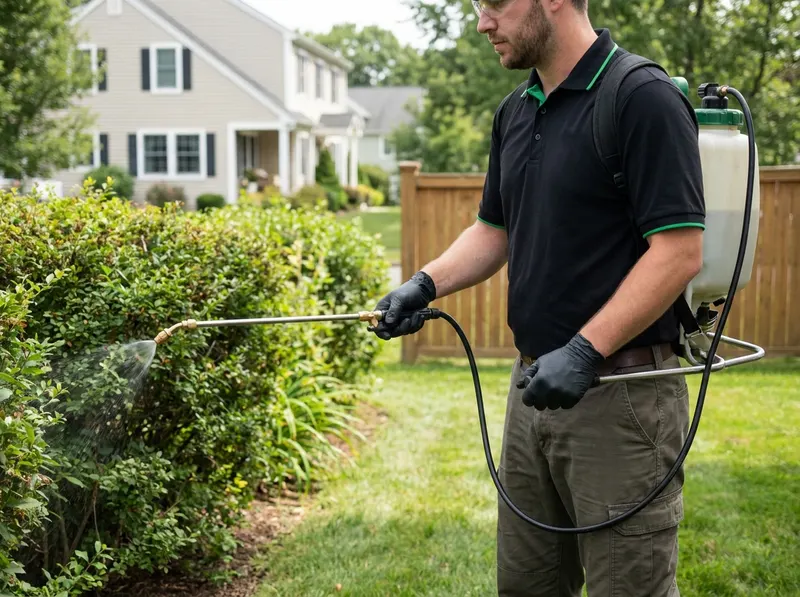
Residential tick and mosquito management in Hartford requires an understanding of localized microclimates and property architecture. Properties situated near dense tree cover, such as residences bordering Keney Park in Blue Hills or the heavily canopied lots throughout the West End, generate sustained humidity beneath deciduous hardwoods. These conditions foster ideal harboring sites for blacklegged ticks carrying Borrelia burgdorferi along leaf-litter transitions. Concurrently, dense urban yards in Barry Square, Behind the Rocks, and Frog Hollow frequently feature uncirculated damp pockets near brick retaining walls, shaded downspouts, and unpaved alleyways that serve as active breeding zones for urban Culex mosquitoes.
Targeted barrier misting delivers micro-encapsulated residuals directly to the underside of broadleaf foliage and dense groundcovers such as pachysandra and English ivy. Treatments remain anchored through routine rainfall, establishing a continuous mortality zone for adult mosquitoes resting during daytime heat. A perimeter band 3 feet out from the lawn edge and 3 feet up into low-hanging brush disrupts the questing behavior of ticks before they migrate into domestic play zones. The application dries in approximately 30 to 45 minutes, after which treated surfaces are safe for children and domestic pets to resume outdoor activity.
Property owners evaluating single-event barrier treatments against retail hardware store foggers face distinct operational differences. Handheld retail aerosol canisters offer transient knockdowns of flying insects within line-of-sight for 4 to 8 hours, leaving questing ground ticks and sheltered mosquito populations unaffected. Professional motorized misting applies calibrated droplets that adhere to the underside of leaves for 21 to 28 days. A standalone application fits specific outdoor gatherings or single-season interventions, whereas ongoing coverage requires targeted reapplication every three to four weeks from May through October; the trade-off is short-term cost control versus sustained seasonal coverage. Property managers near river basin areas such as North Meadows, Parkville, or parcels proximate to South End drainage corridors gain immediate relief from heavy seasonal surges through focused source reduction coupled with exterior barrier defense.
Every job gets a firm, written price after a free on-site visit.
Tell us about your tick & mosquito yard barrier treatment job in Hartford and we'll send a clear, written quote, usually the same day.
 Brinova Pest Services