Historic architecture across Hartford County presents unique vulnerabilities to structural contamination. Multi-story wood-framed homes in the West End, Asylum Hill, and Frog Hollow frequently feature open soffits,…
Historic architecture across Hartford County presents unique vulnerabilities to structural contamination. Multi-story wood-framed homes in the West End, Asylum Hill, and Frog Hollow frequently feature open soffits, aged fascia boards, and fieldstone foundations that allow rodents and bats access to unfinished spaces. Once inside, nesting pests compress thermal insulation and leave behind biological waste containing airborne pathogens such as Hantavirus and Leptospira. Unfinished dirt crawlspaces common in older Parkville and South End residences exacerbate this risk, pulling contaminated air upward through the stack effect into living areas where indoor air quality directly affects occupants.
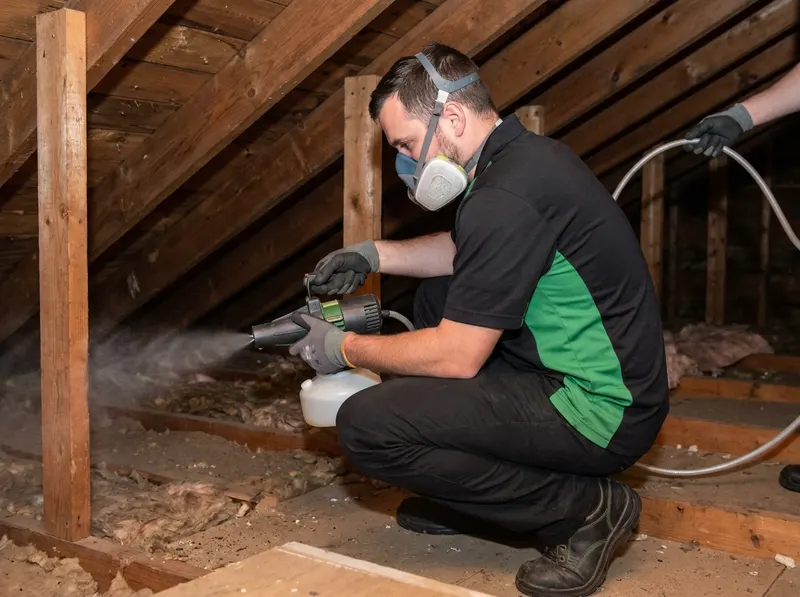
Professional remediators resolve contamination through containment-first protocols rather than simple surface sweeping. Standard household shop vacuums lack the filtration needed for biological hazards; disturbed dry droppings release microscopic particulate that easily bypasses consumer filters and circulates through central HVAC ducts. Treatment requires negative-air machines fitted with 0.3-micron HEPA filtration, followed by complete physical removal of urine-saturated fiberglass or cellulose batting. Technicians then apply hospital-grade, EPA-registered enzymatic antimicrobials using ultra-low-volume (ULV) cold foggers to penetrate porous structural framing, neutralizing bacteria and pheromone trails without leaving toxic pesticide films around domestic living spaces.
Scope requirements dictate whether a localized sanitization or a total structural remediation is necessary. If biological droppings are confined to a single 10-foot run of attic floorboards near an isolated entry point, targeted decontamination and exclusion sealing fulfill the requirement. Conversely, if wildlife has established latrines throughout deep crawlspaces or degraded full-attic R-38 thermal envelopes, full mechanical extraction, structural sanitization, and subfloor sealing are mandatory. Property owners avoid recurring monthly pest contracts through this direct method: the physical bio-load is removed, entry paths are sealed with galvanized steel mesh, and the structure is returned to a clean, measurable baseline.
Every job gets a firm, written price after a free on-site visit.
Tell us about your residential attic & crawlspace sanitization job in Hartford and we'll send a clear, written quote, usually the same day.
 Brinova Pest Services